Serious editorial misconduct: unwarranted removal of an important vaccine study
It showed that infant deaths after vaccination are clustered in the first three days

Editorial misconduct is common, and I have been exposed to it many times.1 Editors protect guild interests, dogma, reputations, and the flow of money from Big Pharma that buys reprints and advertisements and supports scientific societies that publish medical journals.
This spring, Elsevier removed a published article about vaccines entirely, which was an egregious case of editorial misconduct. In 2021, medical research journalist Neil Z. Miller published a study in Toxicology Reports based on the US Vaccine Adverse Event Reporting System (VAERS) database.2 Using a 60-day interval after vaccination, he found that 2605 infant deaths between 1990 and 2019 were far from being randomly distributed: 58% clustered within the first 3 days and 78% within 7 days after vaccination (P < 0.00001).
Miller’s research design was appropriate. Looking for clusters of potential drug harms in databases is a well-established method, which provided support to the suspicion that the HPV vaccines in rare cases cause serious neurological harms.3 And he concluded carefully that his findings did not prove that the vaccines caused the deaths but were “highly suggestive of a causal relationship.”
He also addressed the limitations of his study. People may be more likely to report a sudden death to VAERS if it occurs right after vaccination (reporting bias). However, there were large differences in death rates the first three days. Relatively fewer of the deaths were reported on the day of vaccination (17%) and on day 3 (12%), than on day 2 (29%). For Sudden Infant Death Syndrome (SIDS), the percentages were very similar.
Miller noted that the US Centers for Disease Control and Prevention (CDC) had reported that the median time from vaccination to death was 2 days in 1165 infants who had died suddenly.4 Strangely, the CDC was not concerned about this strong signal of harm.
Miller mentioned a confidential report from GlaxoSmithKline (GSK) made publicly available by the Italian Court, which showed that 63% of 67 infant deaths that occurred within 20 days after a hexavalent vaccine had occurred within the first 3 days. Another confidential report by GSK submitted to the European Medicines Agency (EMA) showed that 53% of the deaths occurred within the first 3 days after a hexavalent vaccine and 82% within the first week.
When discussing why deaths clustered during the first three days, particularly on day 2, Miler referred to theories about the role of inflammatory cytokines as neuromodulators in the infant medulla leading to impeded respiration and quoted studies showing it takes 1-2 days for the cytokines to reach peak levels.
Miller’s discussion section is very long, 8 pages, and I have several reservations. It seems to me that he cherry-picked the references, which include an unpublished lecture and book chapter I could not retrieve. Others are unconvincing. Miller also left out some large studies that did not find an association between vaccination and infant mortality. However, his methods and his result, a clustering of deaths, are convincing.
To put Miller’s findings in proper perspective, we need systematic reviews of the randomised trials, including those that have compared early with late vaccination, because his own research has shown that the death risk is smaller in older children.5 Such trials exist.
Moreover, we need a systematic review of observational studies, with the various biases in such research being addressed in the protocol and carefully assessed in the review.
The removal of the published paper
In December 2025, Lawrence H. Lash, the editor of Toxicology Reports, wrote to Miller about concerns from multiple parties about “potential research errors and misleading statements about vaccine efficacy. The allegations are listed on PubPeer and on another science blog: https://pubpeer.com/publications/C02A9C1F937150E44015877641F4F9
https://threadreaderapp.com/thread/1455831798160764929.html.“
It was not multiple parties. It was just one anonymous person whom I identified from other sources: Magdalen Rose Wind-Mozley from England.
PubPeer is nicknamed PubSmear because professional troublemakers of little of no scientific repute use the platform - often anonymously - to harass scientists whose results they don’t like. Lash’s PubPeer reference includes his second link, which leads to Wind-Mozley’s attacks on Miller’s paper on X under the alias @Rosewind2007.
Clearly, any scientific issues should have been dealt with in letters to the editor in Toxicology Reports, as is usual practice. But this didn’t happen and the correspondence between the journal and Miller and the criticism by Wind-Mozley are so extraordinary that I have uploaded them for the historical record.

Wind-Mozley’s views on vaccines are extreme and often go against the evidence, and her manners towards people who disagree with her are so rude and aggressive that I needed to block her on my X account long ago.
On X, she called for Miller’s paper to be retracted. A few of her comments are relevant but most are not and some are plain wrong. She was true to her usual style:
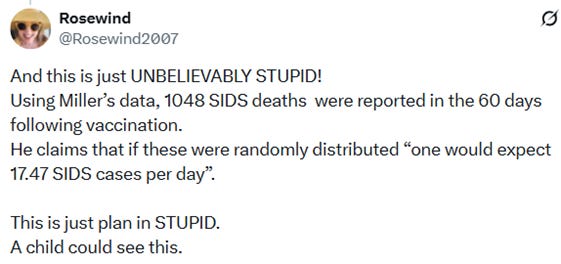
I cannot see that this is stupid but that’s perhaps because I am not a child. There is nothing wrong with Miller’s cluster analysis, but Wind-Mozley continues making inexcusable errors:

Honestly: how the hell did this get published?
“There are 130 official ways for an infant to die, as categorized in the ICD, and one unofficial way for an infant to expire: from a fatal reaction to vaccines.”
This is beyond wrong.
This is just diabolical.
It is not wrong. Miller explained in his article that the International Classification of Diseases (ICD) dropped vaccination as an official cause of death in 1979. The devil is not Miller but Wind-Mozley. Just below “diabolical,” Wind-Mozley shows her extreme bias related to vaccines with the hashtag, #VaccinesWork, and a photo of a mug with “Vaccines work:”
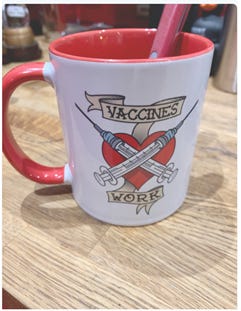
For drugs, including vaccines, it is not enough to say that they work. This is primitive industry propaganda. In my first vaccine book, I explain on the first page:6
“We must evaluate carefully each vaccine, one by one, assessing the balance between its benefits and harms, just as we do for other drugs, and then form an opinion about whether we think the vaccine is worth getting or recommending to other people ... All drugs have harms, and if your risk of contracting an infection is very low, it might not be worthwhile to run the risk of getting seriously harmed by the vaccine, even if this risk is also very low … This is straightforward and uncontroversial, but one reason why vaccines may confuse people is that they have become a battlefield. There are fundamentalists on both sides of the debate who ignore the evidence or manipulate it to further their agendas.”
In his detailed response to Lash, Miller concluded that the criticism raised against his paper does not meet established criteria for retraction under COPE (Committee on Publication Ethics or ICMJE (International Committee of Medical Journal Editors). I agree totally.
However, in February 2026, Miller was told that the editor would remove his paper entirely, for no one to see, because the concerns raised as well as Miller’s response affected the article’s integrity and findings and constituted potentially unsafe research for medical practice. This message was written by Francesco Papi, PhD, Publishing Ethics Expert at Elsevier. It mentioned “potential research errors and methodological flaws.”
This was abhorrent. There was no explanation about what Miller should have done wrong, and he didn’t do anything wrong in relation to what he set out to study: If there was a clustering of the deaths.
Miller requested in his appeal that the proposed removal be withdrawn and that any remaining concerns be addressed through proportionate editorial mechanisms consistent with publication ethics standards. He also sent his concerns to COPE.
He noted that his article could not be potentially unsafe for medical practice because it did not provide clinical guidance or proposed policy changes. It raised a hypothesis and called for further studies. He also explained why it did not meet Elsevier’s withdrawal criteria. Removal is a measure of last resort and not an appropriate response to interpretive disagreement, which should be addressed in a scientific debate.
Miller asked which specific statements or analyses that were deemed potentially unsafe for medical practice and by which mechanisms; which specific Elsevier or COPE criteria for removal that were invoked; and which specific methodological flaws that could affect the article’s integrity and findings.
Lash replied that the decision to retract the paper was based on careful review and consultation with experts and repeated that the paper posed potential risks to public health and should not be allowed to stand. According to philosopher Harry Franklin, this reply to Miller’s relevant questions was bullshit, which he considers comes close to lying.7 It seems to me that the postulated risk is not for the patients but for the establishment.
COPE replied to Miller that their review is limited to the process followed by the journal and that editorial decisions are beyond their remit. They nonetheless repeated the bullshit claiming that the journal gave the concerns due consideration; that the editor determined that the conclusions were not supported and that this undermined the standing of the publication; and that the paper could have a serious health risk to the general public or the environment. Excuse me, but I come to think of Stalin’s show trials. No explanations. Just shoot the guy.
Next, Miller informed the journal and Elsevier that, if they removed his article, they should not justify this by claims of methodological flaws affecting the integrity or findings of the research, as he had refuted such assertions, and that, if it was because of alleged potential risks to public health or to medical practice, the rationale for this should be provided.
Francesco Papi from Elsevier couldn’t care less. He replied that “The journal’s investigation has identified methodological flaws and research errors, including misinterpretation and biased selection and analysis of data. Because the data and findings could be harmful if applied in clinical practice, the Editor has determined that removal of the article is warranted. This decision is final, and we will not engage further on this matter.”
My comments
Miller’s demonstration of a clustering of infant deaths just after a vaccination is important information, which the CDC also published.4 But he became the victim of outrageous editorial and publisher misconduct. And not only him. We are all victims of scientific censorship. It impedes the free flow of ideas and results, to the detriment of science and to our patients.
I find it horrific when some people decide what others are entitled to know. This happens every day but is a constant threat to science and democracy, and it paves the way to dictatorships and theocracies. I fail to understand that some people are so arrogant that they give themselves such powers. It shows a deep disrespect for fellow citizens.
Elsevier removed the article entirely:
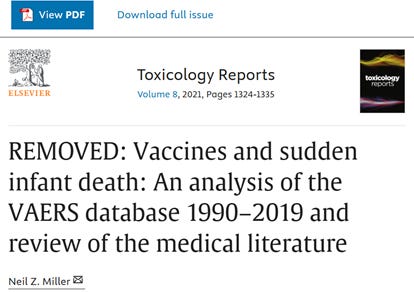
The “View PDF” at the top does not lead to the article, but to a mendacious removal notice.8 It claimed that “readers” (there was only one) had raised concerns about potential research errors and methodological flaws. And that, after an investigation, the journal had identified serious methodological flaws in the use of VAERS data to infer a correlation between vaccination and SIDS.
It was as bad as it gets. No errors were identified and the biases in research using VAERS data are well known and were well accounted for in Miller’s article. The next bit in the removal notice was also mendacious: “Given the inherent limitations of passive reporting systems, including the expected temporal clustering of events independent of causality, the conclusions presented in the article are not supported by the methodology employed.” Miller’s conclusions were appropriate. The Editor-in-Chief ended his notice by talking about the potential implications for medical practice, which is also totally misleading. In essence, what the editor said is that scientific inquiry is a public health hazard.
The PubMed record does not say that the article has been removed or retracted2 and there is a link to the full article in PubMed Central, with no warning about the removal.
More about the influencer, Wind-Mozley
Magdalen Rose Wind-Mozley is a Master of Science but her education is weird: a bachelor in zoology and a master’s in forensic science. She is not a scientist but an influencer. She only has two publications. One is a 2017 letter in a rather unknown journal, NPJ Vaccines, where she accused my research group of being anti-vaxxers already in the title: “Inadvisable anti-vaccination sentiment: Human Papilloma Virus immunisation falsely under the microscope.”9
She denigrated our research about the harms of the HPV vaccines and criticised me for using my centre’s letterhead when I wrote a complaint to the European Medicines Agency (EMA) about their mishandling of the suspicion of serious neurological harms raised by Denmark. I did not have any other letterheads.
She praised the EMA for its work, which failed to find a causal link between HPV vaccines and serious neurological harms. I later published an article about EMA’s mishandling of its investigation10 and documented that EMA committed scientific misconduct.11,12
Denmark’s concerns were partly based on three excellent studies by Doctor Louise Brinth from the Danish Syncope Centre,11 which Wind-Mozley disdainfully called poor-quality studies.
We rebutted her letter but were exposed to serious censorship by the journal’s owner, Springer, that tried to prevent its publication. It took 3 years before it came out and this was only after we had threatened Springer with litigation.11,12
The title of our letter is telling: “Suspicions of possible vaccine harms must be scrutinised openly and independently to ensure confidence.”13 We warned that if well-founded concerns about possible harms cannot be discussed openly for fear of harassment, this would be worrying not only for vaccines but for healthcare in general.
Wind-Mozley’s other letter was a reply to us, with additional misleading claims.14 She claimed we had been wrong in our HPV vaccine research by referring to another influencer, a woman who has hated me intensely ever since I published a review about mammography screening in 2001 that showed that it doesn’t save lives (total mortality and total cancer mortality including breast cancer mortality are not reduced) and is harmful because of overdiagnosis.15 Wind-Mozley also referred to another unwarranted criticism, which included the impossibility that a death disappeared when the follow-up was extended!
More Springer censorship
In 2019, our systematic review of the clinical study reports we had obtained from the EMA of the HPV vaccines was accepted for publication in Systematic Reviews, owned by Springer. However, a year later, it had still not been published, although the journal promises publication within 20 days of acceptance.11,12
We had shown in exploratory analyses that the HPV vaccines increased serious nervous system disorders significantly. But the journal committed editorial misconduct. Our email correspondence with the journal takes up 66 pages, and we received 20 apologies and a variety of odd, contradictory, and implausible reasons for why our paper had not been published.6
When we warned Springer that we would involve our lawyers if Springer failed to publish our review within the next two weeks, they published it with record speed.16
In 2019, I became an expert witness in a lawsuit against Merck related to its HPV vaccine, Gardasil. I read 112,452 pages of confidential study reports and documented the multitude of ways in which Merck committed fraud in its trials, hiding cases of serious neurological harms:11
In June 2026, Merck settled over 200 lawsuits at an alleged cost of over $50 million.12 Based on my extensive investigations, I have no doubt that HPV vaccines in rare cases can cause serious neurological harms that can be irreversible and incapacitating, and that Merck committed fraud by deliberately hiding these harms from public view. I also have no doubt that Merck’s aluminium adjuvant causes harm and that virtually all Merck’s so-called placebo-controlled trials were unethical because the “placebo” group was exposed to a harmful substance, the aluminium adjuvant, which the patients were not informed about.
Other cases of censorship related to vaccines
I have a clear feeling that censorship is worst in relation to vaccines and I know some of the victims personally.
In Spain, farmers had observed serious behavioural changes in sheep vaccinated against blue-tongue disease, which Spanish researchers confirmed in an experimental study in 2013.16
Lluís Luján did a meticulously study that showed that, compared to placebo, sheep injected repeatedly with the aluminium oxyhydroxide adjuvant or the vaccine had fewer affiliative interactions whereas they had increases in aggressive interactions, stereotypies, excitatory behaviour, and compulsive eating.
The study was published online in Pharmacological Research in 2018 but was retracted by the Editor-in-Chief, Professor Emilio Clementi, and is no longer on the journal’s website.
Clementi wrote to Lluís that he had “received serious concerns from the readership,” which he detailed without revealing the sources, which proved to be only one person, likely a troll financed by a vaccine manufacturer. Sounds familiar, right?
The aluminium oxyhydroxide adjuvant is used in the HPV vaccine from GlaxoSmithKline, and when the company did trials of its vaccine, Cervarix, they admitted that it had affected the nervous system but refused to disclose what that meant.12
Danish vaccine researchers Peter Aaby and Christine Stabell Benn have done numerous studies that have shown that non-live vaccines tend to increase total mortality whereas live attenuated vaccines. e.g. the measles vaccine, decrease total mortality more than predicted from their specific effect.17
Vaccine programmes have not yet taken these results into account, including that it is best to end with a live vaccine. Peter started this research decades ago and his results are so groundbreaking that they are on the list of milestones in Nature,18 which starts with the discovery of the smallpox vaccine.
An influencer, Charlotte Strøm, who is a doctor but works as a journalist, succeeded to raise doubts about their research in the Danish media, which went amok and misrepresented the issues, as they always do when they smell blood from highly esteemed medical researchers.
Yet again, the criticism was invalid. It is a long story of censorship that still needs to be told. Christine told some of it on LinkedIn, in Danish.19
In July 2022, Christine uploaded a video with Peter on YouTube about his research in Africa.1 It was mostly about the hugely beneficial non-specific effects of the measles vaccine, but Peter also mentioned his interactions with the WHO about the high-titre measles vaccine, which he showed increased mortality in girls. The vaccine was later withdrawn.
Christine discovered that YouTube had removed the video due to “inappropriate content.”1 She appealed but YouTube didn’t care. They sent a robotic message the next day claiming they had carefully reviewed the content.
When she wrote about her frustrations, she was contacted by Danish TV2. Now, all of a sudden, YouTube uploaded her video again but refused to tell her why even though, according to YouTube’s guidelines, it is not possible to overturn a rejected appeal. Christine said to TV2 that Google’s censorship is toxic because it increases the distrust in the authorities and vaccine hesitancy.20
In 2023, I interviewed Christine about vaccines for our Broken Medical Science film and interview channel.21 We discussed non-specific beneficial and harmful effects of vaccines and why the COVID-19 vaccines were overused, e.g. in children. On a Sunday, in March 2024, my filmmaker tested YouTube’s censorship by uploading the interview. It took YouTube less than an hour to remove it: “Our team has reviewed your content, and, unfortunately, we think it violates our medical misinformation policy.”
We appealed and YouTube’s robot replied: “We reviewed your content carefully and have confirmed that it violates our medical misinformation policy.” It took YouTube less than an hour to evaluate the video carefully, which is impressive, as it lasts 54 minutes.
The video had been online on our own website for six months. We wondered why social media wanted to prevent scientific debate about the benefits and harms of vaccines. Censorship creates distrust in science.
In March 2019, I opened the Institute for Scientific Freedom in Copenhagen and held a symposium about scientific freedom. Morten Hjertholm from Storyboard Productions filmed the lectures for free, as he found our initiative important, and uploaded them on YouTube.22
Two and a half years later, YouTube removed Peter Aaby’s lecture, “Most of you think we know what our vaccines are doing - we don’t.” YouTube explained that it “doesn’t allow content that poses a serious risk of egregious harm by spreading medical misinformation about currently administered vaccines that are approved and confirmed to be safe and effective by local health authorities and by the World Health Organization (WHO).”
There were several links in YouTube’s message but none where it was most needed: “Appeal here.”
We appealed and our complaint was rejected even though we explained that there was no misinformation whatsoever in Peter’s lecture. We also noted that, historically, challenging authorities has been immensely beneficial for mankind and for making scientific progress, and that this is at the heart of science.
The next day, YouTube informed Morten that they had reviewed the content carefully - I wonder if this is ever true - and had confirmed that it violated their medical misinformation policy: “It’s our job to make sure that YouTube is a safe place for all.”
This was bizarre. Censoring scientifically valid and important information about vaccines does not make the world a “safe place for all;” it makes the world a less safe place.
Someone, an influencer I guess, saw the 2.5-year-old video and complained to YouTube, which reacted robotically. I uploaded the video on my homepage23 and published a summary of Peter’s lecture explaining why he disagrees with WHO’s view on the diphtheria, tetanus, and pertussis (DTP) vaccine.23 Which I also do. I was asked to do an expert report and found that Peter’s research is more reliable than that by the WHO expert group.24
Conclusions
It is disgraceful that an influencer who is a scientific nobody succeeded to have Miller’s article removed, with mendacious reasons offered by the journal.
The aim of censorship is to reduce misinformation but it increases it because scientists will, for fear of harassment, tend to say what falls in line with current government policy. The history of medicine is one long record of people suffering because established truths were wrong and dissenters were suppressed, which my own career illustrates.1
We don’t want social media or medical journals to direct us to an Orwellian Ministry of Truth, which are, for example, the websites of governments, the WHO, the CDC or the FDA.
We, the scientists, abhor censorship in medical journals, newspapers, and other media, which is why I named the institute I established in 2019, the Institute for Scientific Freedom.
References
1 Gøtzsche PC. Whistleblower in healthcare (autobiography). Copenhagen: Institute for Scientific Freedom 2025 (freely available).
2 Miller NZ. Vaccines and sudden infant death: An analysis of the VAERS database 1990-2019 and review of the medical literature. Toxicol Rep 2021;8:1324-35.
3 Chandler RE, Juhlin K, Fransson J, et al. Current safety concerns with human papillomavirus vaccine: a cluster analysis of reports in VigiBase (R). Drug Saf 2016;40:81–90.
4 Moro PL, Arana J, Cano M, et al. Deaths reported to the Vaccine Adverse Event Reporting System, United States, 1997-2013. Clin Infect Dis 2015;61:980-7.
5 Goldman GS, Miller NZ. Relative trends in hospitalizations and mortality among infants by the number of vaccine doses and age, based on the Vaccine Adverse Event Reporting System (VAERS), 1990-2010. Hum Exp Toxicol 2012;31:1012-21.
6 Gøtzsche PC. Vaccines: truth, lies, and controversy. New York: Skyhorse; 2021.
7 Frankfurt HG. On bullshit. New Jersey: Princeton University Press; 2005.
8 REMOVED: Vaccines and sudden infant death: An analysis of the VAERS database 1990–2019 and review of the medical literature. Elsevier’s retraction notice, undated.
9 Head MG, Wind-Mozley M, Flegg PJ. Inadvisable anti-vaccination sentiment: Human Papilloma Virus immunisation falsely under the microscope. NPJ Vaccines 2017;2:6.
10 Gøtzsche PC, Jørgensen KJ. EMA’s mishandling of an investigation into suspected serious neurological harms of HPV vaccines. BMJ Evid Based Med 2022;27:7-10.
11 Gøtzsche PC. How Merck and drug regulators hid serious harms of the HPV vaccines. New York: Skyhorse; 2025.
12 Gøtzsche PC. Merck settles lawsuits about serious neurological harms of Gardasil, its HPV vaccine. The European Medicines Agency committed scientific misconduct, too. Substack 2026;June 10.
13 Jørgensen KJ, Auken M, Brinth L, Chandler R, Gøtzsche PC, Jefferson T. Suspicions of possible vaccine harms must be scrutinised openly and independently to ensure confidence. npj Vaccines 2020;5:55.
14 Head MG, Wind-Mozley M, Flegg PJ. Reply: Suspicions of possible vaccine harms must be scrutinised openly and independently to ensure confidence. NPJ Vaccines 2020;5(1):56.
15 Olsen O, Gøtzsche PC. Cochrane review on screening for breast cancer with mammography. Lancet 2001;358:1340-2.
16 Jørgensen L, Gøtzsche PC, Jefferson T. Benefits and harms of the human papillomavirus (HPV) vaccines: systematic review with meta-analyses of trial data from clinical study reports. Syst Rev 2020;9:43.
17 Benn CS, Fisker AB, Aaby P (eds.). Bandim Health Project 1978 – 2018: forty years of contradicting conventional wisdom. 2018.
18 Flemming A. Nature milestones in vaccines. Nature 2020;Sept 28.
19 Christine Stabell Benn. LinkedIn 2025;Dec.
20 Moestrup JHR. Youtube fjernede dansk professors vaccinevideo – så henvendte TV 2 sig, og nu er den tilbage. TV2 2022;July 25.
21 Episode 03: Vaccines, a complicated area. Some decrease total mortality, some increase it, and COVID-19 vaccines are overused. Interview with Christine Stabell Benn. Broken Medical Science 2023;Oct 1
22 Opening symposium for the Institute for Scientific Freedom. 2019;March 9.
23 Gøtzsche PC. YouTube’s removal of a lecture on the effects of vaccines on mortality constitutes horrible censorship. Institute for Scientific Freedom 2021;Nov 17.
24 Gøtzsche PC. Expert Report. Effect of DTP Vaccines on Mortality in Children in Low-Income Countries
Are all vaccine clinical trials that do not use a placebo (inert substance) unethical?
Valuable and pointed analysis of systematic science publisher misconduct!