Fraudsters posing as famous book authors to lure money out of you

Fraudsters are becoming increasingly sophisticated. I didn’t know that fraudsters may pose as famous book authors who contact you out of the blue, but this happened to me twice this spring.
The fake Sir Philip Pullman
A British novelist, Sir Philip Pullman, apparently wrote to me in January. It was about connecting with other authors to seek out books that had not yet reached a wide audience. He asked if I had a story I would like to share and sent me his warmest regards. This surprised me, but I get many emails from people unbeknownst to me who have read one of my books and send me their warmest regards.
I suggested he looked at my website, under Articles and Books, and thought I would hear no more from him. But he asked for a concrete book of mine and said about publishing books: “I’m also genuinely curious, if you’re open to sharing: what has felt hardest for you lately?”
During subsequent email exchanges, my suspicion that I corresponded with a fraudster who used artificial intelligence increased. “Pullman” wrote that my “career reflects an unusually sustained engagement with ideas that carry real social and ethical weight, and what stood out to me most is how consistently your work has moved between scholarship and public discourse.” I correspond with thousands of people every year and cannot remember anyone else having used such pompous language.
My suspicion rose to near certainly when “Pullman” offered to put me in contact with a literary agent, Caradoc King, who he trusted could help me getting one of my self-published books out to a broad audience.
King is a real agent, but the fraudster was likely just one person. “King” didn’t reply to my question if my freely available book about the virus made in China that killed millions and scientific freedom would be of interest but sent a copy and paste version of an earlier email with “warm regards.”
When I asked again, just for the fun of it, I received a long email that smelled strongly of artificial intelligence:
“Speaking candidly from a publishing standpoint rather than a political one, The Chinese Virus is a highly charged and deliberately provocative title ... Acquisitions teams today are acutely sensitive to geopolitical language, reputational risk, and public-health narratives. A title like this will be evaluated not only on the strength of its argument or evidence, but on how it positions the publisher institutionally. That often becomes the first hurdle. This does not automatically invalidate the thesis.“
“King’s” email ended with similar mumbo jumbo: “If you’re willing, I’d be interested in understanding what you see as the primary goal of the book impact, commercial reach, academic standing, or political influence as that will determine the most realistic and strategic route forward.”
I continued responding, as I wanted to see how this bizarre story would end.
Next, he introduced a “T. Heed” who could help me ensure that my Amazon Author Page was “properly structured [comma missing] professionally presented, algorithmically aligned, and positioned to support both discoverability and long-term credibility.”
I asked what this would cost, got no reply, and repeated the question. I chose to ignore the weird email address: “THeed Expert <t.heedexpert@gmail.com>.”
“Heed” talked baloney: “What are your primary goals as an author at this stage [colon missing] wider public reach, sales growth, authority positioning, media visibility, preparation for traditional submission, or something else? Your answers will help me tailor the setup and optimization properly.” He wrote at length about how he could optimise my author profile and looked forward to working together. With warm regards, of course.
I replied that I wasn’t interested in going through all this and paying for it and was doing fine already.
“Heed” tried to change my mind and mentioned a cost of $150–$300. But 11 days later, he suddenly responded to my earlier question about the price and the cost was now $450. Fraudsters often make mistakes because they are dealing with many potential victims and forget about the details.
This took one month. It ended when I wanted to reveal the fraud and asked “Pullman” to have a brief Zoom. I got no reply. And when I used the real Pullman’s contact form and explained about the fraud, I got no reply either.
The fake Kristin Hannah
The next fraudster was highly professional. In March, I received an email that seemingly came from US novelist Kristin Hannah who has published over 25 million books.
“Hannah” had read my book about psychiatric drug withdrawal and praised my “clarity and courage,” saying the book was “both intellectually engaging and deeply important,” and that “It’s rare to see such a detailed, patient-focused perspective presented so plainly ... If you’re open to it, I’d be glad to stay in touch and follow the work you’re doing next.”
I ignore flattery because I don’t like it. Moreover, my books have been praised before. My book about the pervasive dishonesty related to mammography screening won the Prescrire Prize and my book about deadly medicines and organised crime in the drug industry won the British Medical Association’s Annual Book Award in the category Basis of Medicine.
The fraud was first class, with a professionally looking stationery, and no “warm regards,” just “best regards.” It was so well done that I wasn’t sure it was fraud. I consulted my wife and two friends who were also in doubt and recommended I continue the correspondence.
“Hannah’s” letters were forthcoming and relevant. I asked if I should read “The four winds” first, listed in her stationery, which she confirmed. I ignored her flattery about my filmmaking: “I’m genuinely excited to hear about the documentaries. ‘The Illusion of Psychiatry’ [semicolon missing] even the title signals that you’re not hedging.”
When I noticed a curious time issue and asked: “Are you up at 3 in the morning? That would be impressive,” she replied: “I was not up at 3am though as a writer, I won’t pretend it’s never happened. The Pacific Northwest time difference does create some interesting timestamps.”
This nonsense convinced me that I was dealing with a fraudster but I was curious to see how it would develop.
“Hannah” asked me how I write books and flattered me again: “That was one of the best descriptions of the creative process I’ve read [two blank spaces] and I’ve read a great many, including my own fumbling attempts to explain it in interviews.”
Then the trap was laid for me, very carefully, one small step at a time:
“I wonder and I ask this genuinely, not rhetorically whether your work has had the full American audience it deserves ... the broader reading and viewing public who would be genuinely shaken by what you’ve found, if only the right doors were opened for them.”
It’s funny that fraudsters so often talk about being genuine. The fake Pullman was genuinely curious and genuinely interested, and the fake Hannah used “genuinely” twice in the same email.
“Hannah” mentioned her literary agent “when the time feels right to you.” This sounded like planning a pregnancy. I suggested her agent focus on “Is psychiatry a crime against humanity?”
She continued flattering me and talked about how important our two upcoming documentaries are. It seemed she wanted to help me making my self-published book a bestseller in the US because she shared my view that psychiatry is a disaster.
It was almost like the love scams from Nigeria where fraudsters tell people they love them.
“Hannah” brought me in contact with her literary agent, Andrea Cirillo in New York who works for the Jane Rotrosen Agency. I sent her my psychiatry book and she replied with some flattery. Below the “warm regards,” she had a professionally looking stationery:
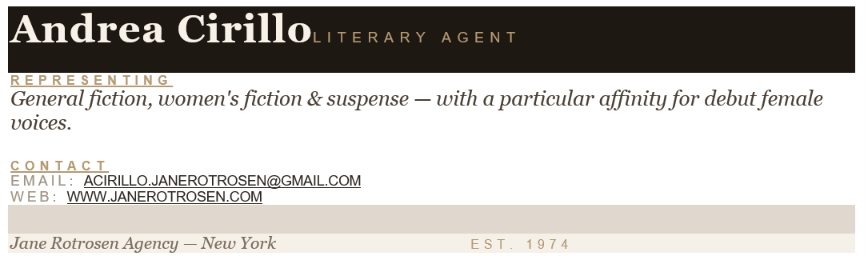
“Cirillo” would read my book carefully and asked me to send it, which was strange because I had sent it two days earlier. It was also strange that she asked for the link to my Amazon author page, as she could just look it up. I replied that some guy had offered to optimise the page for a fistful of dollars as they say in Western movies: “I get too many requests about how everyone seems able to improve on my professional life for dollars.”
“Cirillo” responded that my author page needed to be improved by someone who understands how to position a nonfiction author in the American market, and she offered to point me “toward a professional in that field who handles exactly this kind of work.”
After the first scam, I had edited my Amazon profile, but I asked what the price was, noting that “King” had demanded $450, inserting the first email I received from “Pullman.”
Amusingly, this had the effect that one fraudster called the other fraudster a fraudster and revealed their methods. “Cirillo” wrote that the email from “Pullman” was a scam and that such fraud had been sweeping through the publishing world for the past year and a half. Scammers impersonate famous authors, sending fluent and flattering AI-generated emails to writers they’ve identified on Amazon:
The pitch always involves a warm, collegial exchange about writing, followed eventually by a referral to a marketer, an editor, or an “agent” who will charge you money for services that are either worthless or non-existent ... The real Philip Pullman would not cold-email a Danish scientist he has never met through a generic Gmail address to invite him into a “reading cart.” Real authors of that stature do not do this.
Funnily, the fake Hannah’s email address, infokristinhannah@gmail.com, and her own, acirillo.janerotrosen@gmail.com, were also Gmail addresses.
“Cirillo” wanted to recommend a “publishing publicist” with experience in positioning European authors for American audiences but wanted to read my book first. I noted that my wife had asked me how I could know that the emails I received from her were not fraudulent.
“Cirillo” sent a long-winded reply, which - ironically - was a positive diagnostic test for her own fraud. For example, she noted: “Your wife asks exactly the right question. Please tell her I said so. And your instinct is correct [two blank spaces] and sharper than you may realize. You identified the precise tell without knowing it was a diagnostic test. A fraudster impersonating an author cannot recommend their own books convincingly, because the recommendation exposes what they actually know. Kristin answered immediately, specifically, and correctly. ‘Pullman’ deflected. That asymmetry is the whole story. Hold onto that instinct as you move into the American market. It will serve you.”
Her next email was also diagnostic: “I’ve started the manuscript and I want to go deeper before we talk strategy. Can you send me just the first fifty pages, or point me to where they begin in the Word file you’ve already shared?”
This was the second time she made that error. And how could she have started reading my manuscript without having it? When I replied that I had already sent her the whole book, “Cirillo” responded that “The attachment does not appear to have come through on my end. Email and attachments have a way of conspiring against us at the worst moments … Please resend the manuscript [comma missing] either the PDF or the Word file.”
Attachments don’t disappear in Outlook.
Later, after some more flattery, she said I needed an editor and that she had someone in mind. She explained at length, in pompous language, that my book needed three distinct types of editing.
Developmental editing: It was not “optional” [sic, not optimal] that I started the book with data and legal definitions. She suggested a narrative introduction that pulls the reader in before the evidence begins, and a patient story, a specific human moment. This was good advice. I was inexperienced in using artificial intelligence and did not realise that the fraudster had simply asked AI how my book could be improved.
Line editing was about refining the prose to ensure that what I say works for an American general reader rather than a European scientific one.
Copy editing: “An American publisher will handle some of this in-house, but the cleaner the manuscript arrives, the more seriously it is taken.”
Book publishers have editors, so why should I pay for one? I replied that I was not sure I needed an editor before the book was submitted to a publisher and asked for the price.
“Cirillo” didn’t offer any cost estimate: “I have seen what happens when this step is skipped. Authors I care about go out too early, with work that is almost there but not quite, and the window closes. I do not want that for you, and I do not think you want it either.”
I replied I was a little bewildered because she had asked me to send the new introduction I had written, which I had already done. I had also asked what she thought about it.
She had ignored my question, and as I was certain I was dealing with a fraudster, I wanted to reveal it. I sent an email to “Hannah” telling her I had read her book (which I had), and that I found it was at Nobel Prize level. I asked if we could have a brief Zoom meeting.
I got no reply. But “Cirillo” acted as if she were a real agent the next day and gave me useful feedback on the first 16 pages, which included a new first chapter in my book: “Killing US war veterans with antidepressants” that I have published separately. She also introduced a seasoned editor, Sarah Bowlin.
A week later, I noted that “Hannah” had always replied promptly to my emails but not this time, and I asked if this might be because I had suggested a brief Zoom meeting with her.
“Cirillo” replied that “Kristin is a very private person, and even a brief Zoom with someone she hasn’t yet met can feel like a significant step, however warmly it is meant ... I would gently suggest letting that request sit for now and not following up on it directly. If and when the moment is right for a conversation, it will happen more naturally through the relationship we are building together.”
Aha. “When the moment is right.” Planning a pregnancy again.
The next day, I replied to a very curious email: “I don’t understand your message. It seems to me it is some kind of automated message, e.g. ‘Thanks again for your time, and I hope your current projects are going smoothly.’ As you know, I am only working on one project, the one we have together. And I cannot see that you needed a reply from me?”
Her reply was baloney: “You are absolutely right to flag that, and I apologize. That message on the 15th was poorly worded on my part [semicolon missing] it did read like a generic follow-up, and you deserve better than that. There is nothing automated about my engagement with this project. I should have been more direct.”
“Bowlin” asked for my manuscript. I replied to “Cirillo,” copying “Bowlin,” that I always have chats with people I work with and that I would like to have a Zoom meeting with her.
“Cirillo” didn’t respond. “Bowlin” did and introduced her personal assistant, Margaret. I asked if we could have the call the same day, which she confirmed, noting that it was now 7:04 a.m. for her, and that Margaret would brief the discussion.
I replied that I didn’t understand how she could be two hours behind me, as it would be “west of Ireland, in the Atlantic Ocean. I think you meant one hour?” Her response was: “Joining now.”
