Systematic drug industry corruption and what you can do to protect yourself against drug harms

One of the chapters in my 2013 book is “Organised crime, the business model of big pharma.”1 I document the organised crime and that the industry’s standard response when scandals are revealed in the media - that its practices have changed radically since the crimes were committed - isn’t true.
The crimes are increasing, which is is because the settlements and fines, even when amounting to billions of dollars, constitute a tiny fraction of the earnings by the crimes.
In contrast to the drug industry, doctors don’t harm their patients deliberately. And when they cause harm, by ignorance or negligence, they harm only one patient at a time. As the actions of senior executives in the drug industry have the potential to harm, and sometimes kill, millions of people, their ethical standards should be much higher than those of doctors, and the information they give about their drugs should be as truthful as possible after meticulous and honest scrutiny of the data.
None of this is the case, and when journalists ask me what I think of the ethical standards of the drug industry, I often joke about it and say I have no answer as I cannot describe what doesn’t exist. The only industry standard is money, and the amount of money you earn to the firm decides how good you are, just like in mob circles.
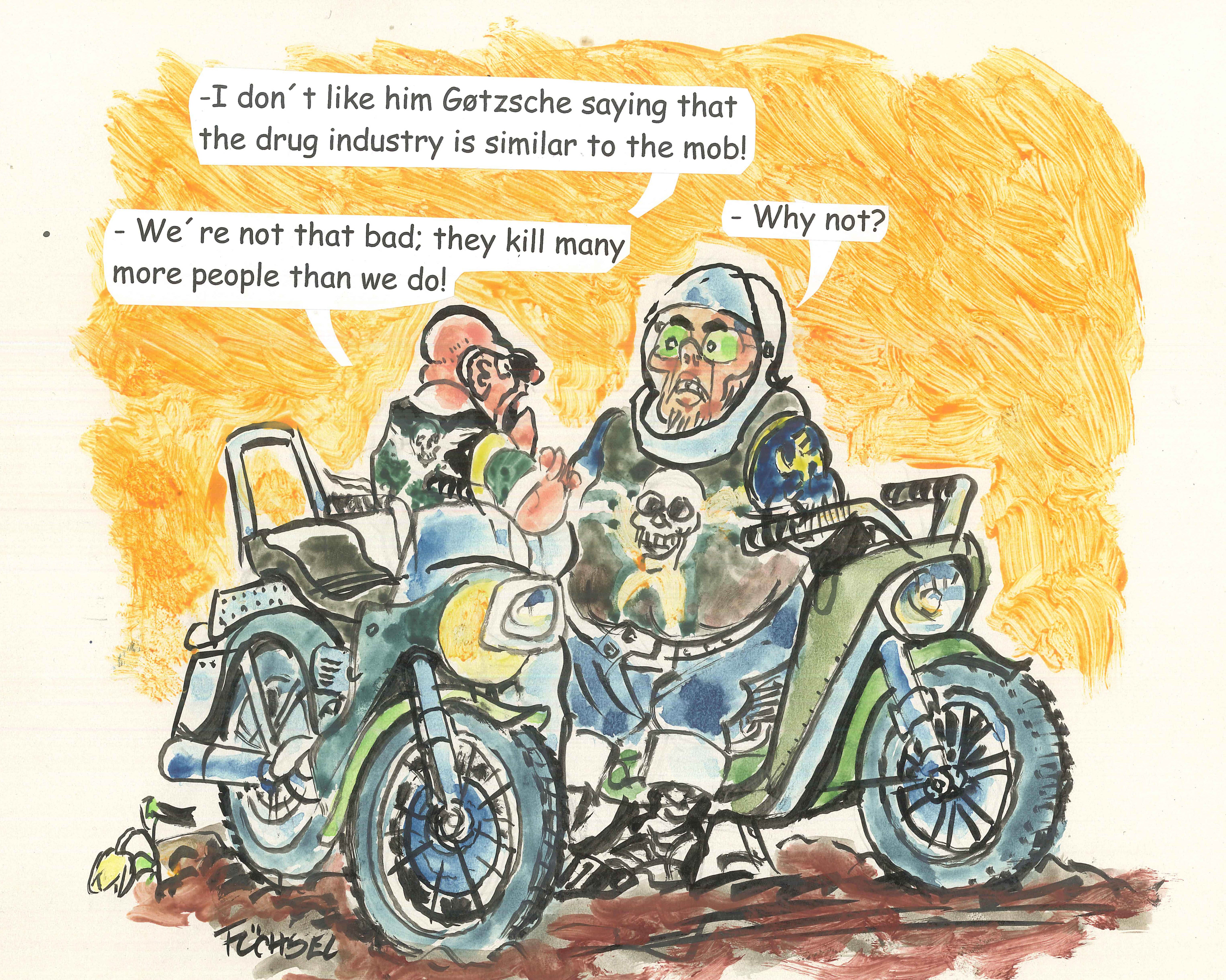
Those who make it to the top in drug firms have been described as “ruthless bastards” by criminologist John Braithwaite who interviewed many of them.2 I noted in my book that in the United States, big pharma beat all other industries in terms of crimes. They have more than three times as many serious or moderately serious law violations as other companies, and this record holds also after adjustment for company size.2,3
Big pharma also has a worse record than other companies for international bribery and corruption and for criminal negligence in the unsafe manufacture of drugs.2,3
Bribery is routine and involves huge amounts of money. It seems that every type of person who can affect the interests of the industry has been bribed: doctors, health inspectors, hospital administrators, cabinet ministers, customs officers, tax assessors, drug registration officials, factory inspectors, pricing officials and political parties.2
The ubiquitous corruption, both in terms of money and in terms of untrustworthy science, explains why our prescription drugs are the leading cause of death, ahead of heart disease and cancer, and that psychiatric drugs alone are the third leading cause of death.4
When bodies are piling up on the autopsy table, the industry has another standard response, which is that we see a bad apple. Not so. The whole barrell is rotten to the core.
The current situation
In June 2026, US law professor Marc A. Rodwin provided an overview of the corruption based in particular on an analysis by other authors of all reports included in 21 OECD studies of cross-border bribery.5
Rodwin’s article shows that Braithwaite’s book from 19842 is still highly relevant. Nothing material has changed in all those years, at least not for the better.
Drug companies still bribe virtually any type of person who can influence drug usage. They rely on payment from subsidiaries to bypass internal company controls and they provide payments in return for prescriptions or purchases.
Company personnel often generate false invoices or disguise bribes as payment for legitimate business transactions, but the payment can exceed market rates hugely, which I have seen myself. When I worked at Astra-Syntex with clinical trials 50 years ago, before I became a doctor, we had a consultant, rheumatologist Jørgen Gylding-Sabroe, who got an annual honorarium corresponding to my salary in six months.6 I estimated that he didn’t work for us more than a couple of days a year. He was positive towards our arthritis drug, naproxen, so the marketing people likely felt they got value for money, which I doubted. He was not a leading figure and his main interests were in cooking and history.
Companies disguise bribes as payments for services to third-party vendors, charitable contributions to philanthropic foundations, or funding for clinical research.5
To disguise who receives payments, pharma firms transfer funds to shell companies, misrepresent financial transactions, and falsify documents in records and audits. Companies sometimes offer discounts on products sold to distributors who make payments to obtain regulatory approval or procurement contracts.
Companies characterise bribes to individuals as honoraria; fees for speaking, consulting, or marketing; professional expenses; or loans. Or they record the bribes as a permissible gift, hospitality for professionals as part of marketing, financial support for conferences, or professional education.
In addition to cash payment, bribes include luxury goods such as cameras, jewelry, watches, electronics, wine, shopping vouchers, or family vacations.
So, what can you do?
About 30 years ago, one of my US colleagues turned up at a scientific meeting with a badge she had produced with the message: “Trust me, I’m a doctor.”7
We were a group of people championing the new movement of evidence-based medicine where we make decisions about healthcare based on the most reliable scientific evidence we have, in contrast to eminence-based medicine where you trust your doctor blindly.
We had a big laugh. The irony was that you should always ask critical questions of your doctor to protect yourself against drug harms.
Most people let their doctor make the decisions for them, but the evidence tells us that we should be cautious. Doctors make many errors of judgment, and they get much of their information from the drug industry. They therefore use far too many drugs, often because they don’t know better.
The shocking result of this is that family doctors kill one of their patients every year, on average, in good faith.8 But you should not skip your family doctor and consult a specialist instead, as this is even more dangerous. A study that compared 3075 US counties found that every 20% increase in primary care physicians was associated with a 6% reduction in total mortality.9
You should avoid taking drugs unless they are absolutely necessary, which they rarely are. You might think it is too difficult for you to find this out but it is often easier than you think. I wrote a whole book to help patients look up the evidence themselves and judge if it is reliable or not.8
Artificial intelligence can also be useful but it is tricky and may give you the wrong answer. Fluoxetine was the first antidepressant approved for children, and I asked Grok on X if this was correct, just to test it. I was told that “Fluoxetine stood out as the first with strong evidence from pediatric trials supporting its use for depression.” Strong evidence supporting its use in children when it doesn’t work for children10 and doubles suicides in adults and very likely also in children?11,12 This is as bad as it gets.
Since artificial intelligence reflects what is out there, which can be horribly misleading, particularly in relation to psychiatric drugs,13 it is most useful when it tells you that something is controversial. In that case, it will usually be prudent not to take the drug in question.
You should ask your doctor if there are other options than drugs and if it could be okay not to receive any treatment at all. Very few patients benefit from the drugs they take,1,13 and the same can be said about many other interventions.6
Above all, you should avoid the biggest killers, opioids, NSAIDs (pain-relieving agents such as ibuprofen) and drugs for mental health issues. That a drug killed a patient is usually invisible to doctors, which means that they don’t learn anything from their mistakes. When a patient dies due to an NSAID, the drug may have caused a stomach ulcer or heart attack, but that might have happened without medical treatment.
As another example, deaths caused by depression pills and other brain-active drugs are often related to balance issues. When older people fall and break a hip, about one in five will die within a year. Their doctors don’t think these deaths may be due to the drugs because so many old people fall and break a hip anyway. But most drugs in common use are likely to affect the brain and may lead to falls. In the elderly, drugs against increased blood pressure should also be used with caution.
As very few drugs are indispensable, you might try now and then to taper off slowly one drug at a time and see how it goes. Perhaps your blood pressure, cholesterol, or blood sugar remains low without the drug. Taper attempts are best done in collaboration with your doctor.
Many people who have tried this have discovered that a life without drugs is possible and that their tiredness, muscle pain, memory problems, or impotence disappeared. People rarely think such symptoms might be caused by the drugs they take, rather than by their advanced age.
Although I am a specialist in internal medicine and am old, I only take a drug when I am very ill, which usually means that I have a life-threatening infection. I exercise a lot and enjoy life, and my motto is: “Don’t worry, be happy.” As we shall all die, we should not be afraid of this but should enjoy living. Drugs cannot help us with that but they can prevent it. And often do.
References
1 Gøtzsche PC. Deadly medicines and organised crime: How big pharma has corrupted health care. London: Radcliffe Publishing; 2013.
2 Braithwaite J. Corporate Crime in the Pharmaceutical Industry. London: Routledge & Kegan Paul; 1984.
3 Clinard MB, Yeager PC. Corporate Crime. New Brunswick: Transaction Publishers; 2006.
4 Gøtzsche PC. Prescription drugs are the leading cause of death. And psychiatric drugs are the third leading cause of death. Mad in America 2024;April 16.
5 Rodwin MA. Probing the prevalence of pharmaceutical corruption. J Law Med Ethics 2026;54:130-142.
6 Gøtzsche PC. Whistleblower in healthcare (autobiography). Copenhagen: Institute for Scientific Freedom; 2025 (freely available).
7 Gøtzsche PC. ”Trust me, I’m a doctor.” CrossFit 2019;June 16.
8 Gøtzsche PC. Survival in an overmedicated world: look up the evidence yourself. Copenhagen: People’s Press, 2019.
9 Starfield B, Shi L, Grover A, Macinko J. The effects of specialist supply on populations’ health: assessing the evidence. Health Aff (Millwood) 2005; Jan-Jun;Suppl Web Exclusives:W5-97-W5-107.
10 Gøtzsche PC. A story of bad science: How defenders of antidepressant efficacy make their case. Mad in America 2026;July 28.
11 Gøtzsche PC. Antidepressants are major drivers of suicides. But authors of suicide prevention articles ignore the elephant in the room. Mad in America 2026 (in press).
12 Gøtzsche PC. Observational studies confirm trial results that antidepressants double suicides. Mad in America 2025;Feb 8.
13 Gøtzsche PC. Is psychiatry a crime against humanity? Copenhagen: Institute for Scientific Freedom 2024 (freely available).
Recently, I've seen research proposing that Big Pharma is not just organized crime, but state-corporate crime: government regulators too are complicit if they passively permit unauthorized practices (e.g., being slow to correct marketing that runs afoul of the law), or of course if regulators actively encourage misconduct. I'll have to check out your 2013 book.
A transformation of society that reorganises power around the principle called self-regulation.
A principle inherent in all natural processes and forms the basis of their development.
Humans within the repressive society, have largely buried self regulation within themselves and created structures of self-control, control of nature and control of people, which have brought about an ever-increasing degree of destruction of inner and outer nature.
https://vegetativetraining.wordpress.com/self-regulation-confronting-tyrants-and-achieving-freedom-through-rage/