
My research has often made powerful doctors, industry people, so-called public health experts, and others angry.1 Not because there are faults with it. I have published over 100 papers in “the big five” medical journals; my scientific work has been cited over 190,000 times; and I have published over 50 papers with one of the world’s finest biostatisticians, the late Douglas Altman.1
People get angry when I reveal, like the little boy in H. C. Andersen’s wonderful fairy tale, that their medical emperor has no clothes:
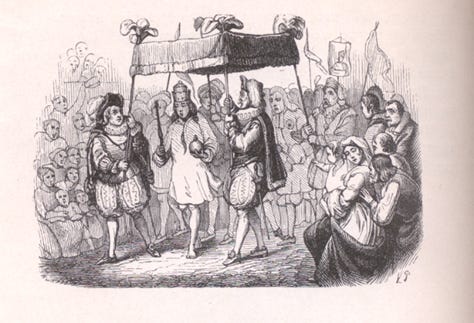
When my research had been mentioned on the frontpage of the New York Times three times in just three years,2-4 one of their reporters visited me in my home and wrote an article about a career that bristles with against-the-grain conclusions.5 He noted that I do not seem a man whose bite is much worse than my very gentle bark, “But this tall, gray-haired statistician is sending some eminent doctors into fits of apoplexy as he quietly implies that they’ve wasted their lives defending old wives’ tales, maltreated their patients or assisted in frauds that perhaps ought to land them in jail.”
I am a biologist and a doctor and have studied statistics extensively.1 My constant shaking up of the medical research world often involved statistics. For my doctoral thesis, I analysed all head-to-head comparisons of nonsteroidal, anti-inflammatory drugs (NSAIDs), 196 in total, and showed with statistical methods that the results couldn’t be true.6
This was the first time a whole research area had been scrutinised with statistical methods, and my two opponents were so shocked that they thought this area was exceptionally bad. Later, I showed that it wasn’t a lone rotten apple. The whole barrel of drugs is rotten, which is why our drugs are the leading cause of death, ahead of heart disease and cancer.7
My thesis became widely known. Douglas Altman found it in the library and urged Iain Chalmers in Oxford to read it. Three years later, Iain founded the Cochrane Collaboration, with Doug, me, and 74 others.1
I have often been harassed in the academic world because I broke the omertà and was the first to document fraud in a therapeutic area.1 When I got the HealthWatch Award in London in 2016, I started my talk this way:8
“People ask me, why do you look for controversies? And I tell them, I don’t, they come to me. My work is something like that of a medical detective. People come to me if they feel something is wrong in healthcare. When I start looking into these issues, I usually dig very deep. I find skeletons, and when I expose these skeletons, the people who buried them can get very angry.”
In the following, I shall summarise some of my rocking the boat experiences.
Of mites and men
Little did I know when I, in 1996, decided to do a Cochrane review of the randomised trials of physical and chemical methods against house dust mites that this therapeutic area was dominated by dishonesty, fraud and corruption and that we would be exposed to serious editorial misconduct in Cochrane.9 Virtually all our persecutors were men.
Nothing works, but the editor of the Cochrane Airways Group, Paul Jones, changed our abstract behind our backs after we had approved the review for publication so that it became more positive. He also ensured that the publication was considerably delayed. In the meantime, an application for yet another trial had been granted public funding amounting to the huge sum of £728,678.
If our review had been published, the trial would likely not have been funded. It didn’t change our results, which I knew would be the case, given my statistical background. We complained to Jones about his misconduct, but after we updated the review, he changed the abstract again without our knowledge.
What happened subsequently when the “experts” and authorities desperately tried to protect the naked emperor could have been a hilarious episode in Monty Python’s Flying Circus.9 I can imagine John Cleese shooting the mites, one by one, with a bazooka. One of the experts who had not lost his mind noted that wrapping the mattress in allergen-proof mattress covers can best be compared to emptying the Atlantic Ocean with a teaspoon.
Pfizer ties the legs of the competitors’ racing horses and wins
I did some Cochrane reviews of antifungal agents with my wife and we found out that this area had been corrupted by commercial incentives and fraudulent trials.1
Pfizer had rigged a series of drug trials so that they favoured their drug, fluconazole, over the comparators. We published our revelations in JAMA in 1999,2,10 and the editor, my good friend Drummond Rennie, said that Pfizer had tied the legs of the competing racing horses and had told everyone that they were much slower than its own horse.11
Pfizer had combined the results for amphotericin B with those for nystatin, even though it was well known that nystatin is ineffective, and gave amphotericin B orally to most patients, although it is poorly absorbed and should be used intravenously.
My wife presented our results at a big international congress in Toronto in 1997, ICAAC. The two chairs allowed many questions, extending her presentation by half an hour, which is unheard of at such a large meeting. The chairs had been involved with some of the rigged studies and were thrilled that Pfizer’s fraud at long last was exposed publicly.
We also demonstrated that Pfizer committed scientific misconduct in their trials of another antifungal drug, voriconazole.12 The misleading trial reports were published in the New England Journal of Medicine, which earns a lot of money on selling reprints of the industry’s dishonest reports.13 The reports were cited much more than average,1 and we observed in a random sample of 25 references to each trial that the unwarranted conclusions were uncritically propagated.14 This is how Big Pharma steals money from the taxpayers while the big medical journals act as willing mouthpieces for the fraud and prosper, too.
Pfizer’s frauds are typical examples of how drug firms and journals operate. Drummond was once dragged into court by Pfizer after a lecture where he said that Pfizer laughed all the way to the bank. Pfizer’s lawyer, devoid of humour, asked Drummond: “Which bank?”1
The powerless placebo
The usefulness of a paper could be judged by the number of previous papers it renders superfluous. On that count, our systematic review of 130 randomised trials of the effect of placebo compared to no treatment, published in the New England Journal of Medicine in 2001,15 was extremely useful. It threw out the window 46 years of placebo research.
We did our study out of curiosity and thought there were important placebo effects. Over and over, medical journals and textbooks had asserted that placebo was so powerful that 35% of the patients improved on average. We wondered where this information came from.
Every paper referred to other papers, which referred to yet other papers. It was like peeling back an onion before we finally found a paper published in JAMA in 1955.1 It concluded that placebos had a high degree of therapeutic effectiveness in 35% of the patients, but the vast majority of the studies, and the article itself, had erroneously estimated the effect of placebo as the before-after difference in patients in a placebo group of a randomised trial. This ignores the spontaneous improvement that often occurs without treatment.
We did not find any noteworthy effects of placebo. Our review astonished the medical world and readers of the New York Times.3 People dismissed it with the weirdest arguments, including referring to their own undocumented feelings or opinions.3
Our paper was very threatening to people who had built careers on the placebo effect, and we spent quite some time during the next six years refuting flawed or erroneous analyses and invalid arguments.1 We also published a Cochrane review, which we updated, now with 234 trials.16
The case is settled. Which is rare in healthcare research. But doctors continue to talk about important placebo effects and continue to refer to the before-after change in one group. It is very easy to fool people but very difficult to convince them that they have been fooled.
Mammography screening, the great hoax
Breast screening displays all the worst elements in science:1 Flawed research, fraud, blatant lies, censorship, editorial misconduct, unwarranted retraction of a very important article17 suggesting a key trial was fraudulent, which we subsequently published in another journal,18 harassment, threats of litigation, death threats, serious misinformation from the authorities, lack of informed consent, a gigantic waste of money, and abuse of academic positions to suppress unwelcome research. It can hardly be worse than this.
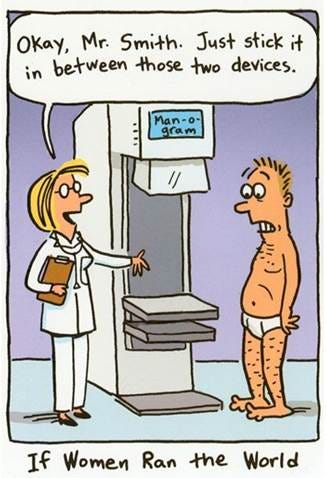
The two main arguments for screening, saving lives and breasts, are both false.19,20 Ironically, the total war against science, common sense and decency, which has harmed women, has almost exclusively been conducted by hyperaggressive males. What if women ran the world:
I wrote two books about this19,20 and explained in July 202621 that the debate I started in 2000 lasted 12 years until the UK Cancer Empire killed it with a flawed “Yes, Minister” report that wasn’t even a systematic review in The Lancet, which starred as the establishment’s useful idiot by propagating egregiously false messages to the public.
The biggest scandal in Cochrane’s history was when the Australian-based Cochrane Breast Cancer Group, funded by the centre offering screening, in 2001 refused to let us include the data on the worst harms of screening, overdiagnosis and overtreatment of healthy women in our Cochrane review, even though these outcomes were in our protocol the group had published.22 Our full review, including the harms, came out in The Lancet instead.23
It took me five years, with repeated complaints to the Cochrane leaders, before we were allowed to add the harms of screening to our Cochrane review, but Cochrane learned nothing from its grave mistake. In 2025, Cochrane refused to publish the 4th update of our review where we had added more deaths. It was an act of horrific censorship.22
The Texas sharpshooter fraud
In the early 2000s, it was impossible to obtain access to trial protocols submitted to research ethics committees but I succeeded with it in Denmark and involved Douglas Altman.
I was dissuaded to do the research by a civil servant who seriously doubted we would get anything out of it. His trump card was that all the protocols had assembled dust in a basement full of spiders. “Fine,” I said, “We’ll work with the spiders.”
Our research was ground-breaking. We compared 102 protocols for randomised trials with trial publications and discovered that two-thirds of the trials had at least one primary outcome that was changed, introduced, or omitted while 86% of the trialists denied the existence of unreported outcomes (they didn’t know, of course, that we had access to their protocols when we asked).24 These manipulations were not described in any of the publications, and the changes we found were not exactly minor.
It was the first time that this fraud had been studied systematically, and we were astonished that it was so common. What we uncovered is now known as the Texas sharpshooter fraud. You fire a gun towards a target but miss it. Next, you wipe out the target and draw a new one around your bullet hole and present this to the public.
The industry is in total control over a trial in progress
We published another study based on these data and found that, in 44 industry-initiated trials, the sponsor had potential control over a trial in progress in 73% of the cases.25 That the sponsor could stop the trial at any time was only noted in one publication but repeated peeps at incoming data creates a risk that the trial will be stopped at a favourable time.
None of the protocols or publications stated that the investigators had access to all the data. Half of the protocols noted that the sponsor either owned the data, needed to approve the manuscript, or both. None of these constraints were stated in any of the publications.
When I republished our paper in Danish, the Danish Association of the Pharmaceutical Industry lost their mind. They said they were “shaken and enraged about the criticism” that they could not recognise, which was hypocritical, as we had merely reported what they knew international drug companies write in their trial protocols.
They harassed us by filing a groundless case alleging we had committed scientific misconduct by deliberately distorting the data. The Association copied some of its letters to the management at Rigshospitalet, where four of us worked, to the Copenhagen Hospital Corporation, the Central Research Ethics Committee, the Danish Medical Association, the Danish Drug Agency, the Ministry of Health, the Ministry of Science, and our medical journal. They spared our Queen and Prime Minister and the Pope.
After we had been acquitted, the Association continued to insist we were guilty of scientific misconduct. They lied brutally in their press releases,1 and even seven years later, industry people lied about our research and acquittal.
During all this brouhaha, a BMJ editor visited me and I told her about the non-existing “case” against us. She burst into laughter. She couldn’t imagine why anyone would be foolish enough to accuse Douglas Altman, their statistical adviser, and me of scientific misconduct. She asked me to write a paper about the affair, which I did. However, as BMJ’s lawyer was worried about possible litigation, my paper was transformed into an article written by a journalist.26 As I had done most of the work, it was inappropriate that I was not an author, but I was happy that the Danish drug industry was ridiculed.
Cheating and lying is Big Pharma’s business strategy. They don’t sell drugs; they sell lies about drugs.27,28
The truth about organised crime in the drug industry was taboo
When I decided in 2007 to write about organised crime in the drug industry, academic corruption and lethal failures in drug regulation, I wasted five years banging my head against closed doors in eight medical journals even though the crimes were well-known.1
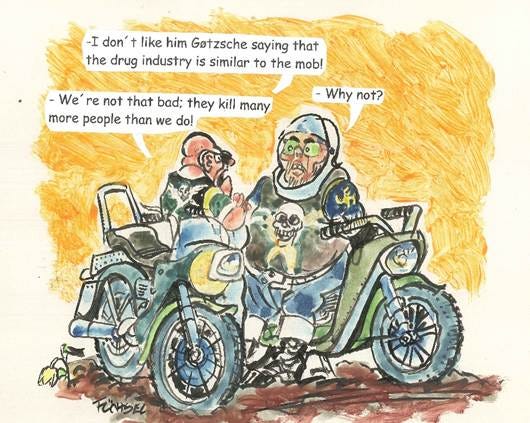
My paper came out in the BMJ29 only four months after PLoS Medicine had questioned if the fraud was deliberate, which is ridiculous. Organised crime is not committed by accident. The BMJ allowed me to say that the crimes were likely committed deliberately - because crime pays – and that doctors are often complicit.
But BMJ censored me. I had to use the euphemistic term corporate crime. But I published a comprehensive book a year later, “Deadly medicines and organised crime: How big pharma has corrupted healthcare,” which documented that, according to US law, the business model of the ten biggest drug companies is organised crime that kills millions of patients.27
I got a lot of flak from doctors on the take and from the drug industry with a myriad of false claims about what I had written in my book.1 This is the standard script in healthcare: If you can’t beat him, lie about him.
Psychiatry, a crime against humanity
After having studied psychiatry in detail for 18 years, I concluded that it is the only medical specialty that survives on lies.30 I explain in a freely available book why psychiatry is a crime against humanity according to the Rome Statute of the International Criminal Court, Article 7.31 It was downloaded over 1000 times in the first three days after publication.
You don’t attack a whole specialty and document that it kills millions of people every year7,28 unscathed.1 My research articles and books were such a threat to psychiatry and Cochrane, which has published numerous deeply flawed reviews of psychiatric drugs,1 that I had to disappear, as they say in mafia circles, which Cochrane succeeded doing in 2018 after one of the worst show trials ever in academia.1,32
Later this month, our documentary films about this33 and about the illusion of psychiatry34 will have world premiere in Norway.
I warned Cochrane before they unleashed the academic guillotine that I would survive but that I was not so sure about Cochrane. Looking back, it is clear that Cochrane lost its reputation1,35 when it sacrificed – as they say in religious circles – one of their most prominent researchers and contributors, also financially, to please the angry industry gods.
Opening up EMA’s archives
In 2010, after a three-year battle with the European Medicines Agency, which was only concerned with protecting the drug industry’s commercial interests, not the patients, we had received so much support from the European Ombudsman that the EMA had no other option than to open its archives of clinical study reports.1,34
Cochrane should have been elated because Cochrane reviews of drugs based on published trial reports are usually misleading. But it wasn’t. The greatest achievement in my career was seen as a nuisance because it would involve more work for Cochrane authors to read the voluminous clinical study reports.
This was one of many signs1,35,37-43 that Cochrane no longer heeds its founding principles of which the most important one is about minimising bias and avoiding conflicts of interest.44
It should have been celebrated all over the world that we, for the first time, had got access to drug company reports at a drug agency. The silence was daunting. I realised that people prefer fairy tales about how good our drugs are, rather than facing the truth.
General health checks
General health checks, called annual physicals in the United States, are popular, but we showed in 2012 that they don’t reduce mortality, and with 21,535 deaths in our most recent update, our results are very convincing.45
In Denmark, we don’t invite people for general health checks but they already did that in the UK where our review had an effect like sticking a pin in a hornet’s nest. Public servants were so dishonest that it reminded me of an episode in the ”Yes, Minister” BBC satire series where the minister says: ”I don’t want the truth, I want something I can tell Parliament!”
The reactions to our review, also in Denmark,45 were farcical and very depressing for those who believe the public deserves honest information about screening.
Final words
I have provided a little collection of the absurdities I have been exposed to in healthcare when I showed the emperor was naked. There are many more in my autobiography.1
You will not be surprised that, when I was once asked what the biggest obstacle in my career had been, I responded promptly: Stupidity. It’s endless.
References
1 Gøtzsche PC. Whistleblower in healthcare (autobiography). Copenhagen: Institute for Scientific Freedom; 2025 (freely available).
2 Grady D. Medical journal cites misleading drug research. New York Times 1999;Nov 10:1.
3 Kolata G. A study casts doubt on the placebo effect. New York Times 2001;May 24:1.
4 Kolata G. Study sets off debate over mammograms’ value. New York Times 2001;Dec 9:1.
5 McNeil DG Jr. Confronting cancer: scientist at work – Peter Gotzsche; a career that bristles with against-the-grain conclusions. New York Times 2002;Apr 9.
6 Gøtzsche PC. Bias in double-blind trials. Dan Med Bull 1990;37:329‑36. The thesis consisted of 6 papers and a review of the research area: Gøtzsche PC. Reference bias in reports of drug trials. BMJ 1987;295:654‑6; Gøtzsche PC. Patients’ preference in indomethacin trials: an overview. Lancet 1989;i:88‑91; Gøtzsche PC. Methodology and overt and hidden bias in reports of 196 double-blind trials of nonsteroidal, antiinflammatory drugs in rheumatoid arthritis. Controlled Clin Trials 1989;10:31‑56 (amendment:356); Gøtzsche PC. Multiple publication in reports of drug trials. Eur J Clin Pharmacol 1989;36:429‑32; Gøtzsche PC. Review of dose-response studies of NSAIDs in rheumatoid arthritis. Dan Med Bull 1989;36:395‑9; Gøtzsche PC. Meta-analysis of grip strength: most common, but superfluous variable in comparative NSAID trials. Dan Med Bull 1989;36:493‑5.
7 Gøtzsche PC. Prescription drugs are the leading cause of death. And psychiatric drugs are the third leading cause of death. Mad in America 2024;April 16.
8 Gøtzsche PC. Why is it controversial to tell the truth about health care? HealthSense 2016;issue 104:6-8.
9 Gøtzsche PC. House dust mite control measures for asthma have no effect but that’s not what you hear. Three decades of nonsense and dishonesty. Gøtzsche’s Perspective 2026;July 13.
10 Johansen HK, Gøtzsche PC. Problems in the design and reporting of trials of antifungal agents encountered during meta-analysis. JAMA 1999;282:1752–9.
11 Astrup N. Uærlighed koster dyrt. Ugeskr Læger 1999;161:6666-8.
12 Jørgensen KJ, Johansen HK, Gøtzsche PC. Voriconazole versus amphotericin B in cancer patients with neutropenia. Cochrane Database Syst Rev 2006;1:CD004707.
13 Lundh A, Barbateskovic M, Hrobjartsson A et al. Conflicts of interest at medical journals: the influence of industry-supported randomised trials on journal impact factors and revenue - cohort study. PLoS Med 2010;7:e1000354.
14 Jørgensen KJ, Johansen HK, Gøtzsche PC. Flaws in design, analysis and interpretation of Pfizer’s antifungal trials of voriconazole and uncritical subsequent quotations. Trials 2006;7:3.
15 Hróbjartsson A, Gøtzsche PC. Is the placebo powerless? An analysis of clinical trials comparing placebo with no treatment. N Engl J Med 2001;344:1594-602.
16 Hróbjartsson A, Gøtzsche PC. Placebo interventions for all clinical conditions. Cochrane Database Syst Rev 2010;1:CD003974.
17 Gøtzsche PC, Mæhlen J, Zahl PH. What is publication? Lancet 2006;368:1854–6.
18 Zahl P-H, Gøtzsche PC, Andersen JM, Mæhlen J. Results of the Two-County trial of mammography screening are not compatible with contemporaneous official Swedish breast cancer statistics. Dan Med Bull 2006;53:438-40.
19 Gøtzsche PC. Mammography screening: truth, lies and controversy. London: Radcliffe Publishing; 2012.
20 Gøtzsche PC. Mammography screening: the great hoax. Copenhagen: Institute for Scientific Freedom; 2024 (freely available).
21 Gøtzsche PC. How the UK Cancer Empire killed the debate on mammography screening. And how The Lancet starred as the establishment’s useful idiot. Gøtzsche’s Perspective 2026;July 7.
22 Gøtzsche PC. Cochrane on a suicide mission. Brownstone Journal 2025;June 20.
23 Olsen O, Gøtzsche PC. Cochrane review on screening for breast cancer with mammography. Lancet 2001;358:1340-2 and Olsen O, Gøtzsche PC. Systematic review of screening for breast cancer with mammography. Lancet 2001;Oct 20.
24 Chan A-W, Hróbjartsson A, Haahr MT, et al. Empirical evidence for selective reporting of outcomes in randomized trials: comparison of protocols to published articles. JAMA 2004;291:2457-65.
25 Gøtzsche PC, Hróbjartsson A, Johansen HK, et al. Constraints on publication rights in industry-initiated clinical trials. JAMA 2006;295:1645-6.
26 Gornall J. Research transparency: industry attack on academics. BMJ 2009;338:626–8.
27 Gøtzsche PC. Deadly medicines and organised crime: How big pharma has corrupted health care. London: Radcliffe Publishing; 2013.
28 Gøtzsche PC. Deadly psychiatry and organised denial. Copenhagen: People’s Press; 2015.
29 Gøtzsche PC. Big pharma often commits corporate crime, and this must be stopped. BMJ 2012;345:e8462.
30 Gøtzsche PC. The only medical specialty that survives on lies. Brownstone Journal 2025;Sept 8.
31 Gøtzsche PC. Is psychiatry a crime against humanity? Copenhagen: Institute for Scientific Freedom 2024 (freely available).
32 Gøtzsche PC. The decline and fall of the Cochrane empire. Copenhagen: Institute for Scientific Freedom; 2022 (freely available).
33 Bang J, Gøtzsche PC. Silence of the truth: When health becomes big business and people die. Inland University annual research days, Lillehammer, Norway 2026;Sept 23.
34 Bang J, Gøtzsche PC. The illusion of psychiatry. Mad in Norway Film Festival, Lillehammer, Norway 2026;Sept 26.
35 Gøtzsche PC. Requiem for the Cochrane Collaboration. Brownstone Journal 2025;July 18.
36 Gøtzsche PC, Jørgensen AW. Opening up data at the European Medicines Agency. BMJ 2011;342:d2686.
37 Gøtzsche PC. Cochrane recommends antidepressants for anxiety in a garbage in, garbage out review. Mad in America 2025;July 29.
38 Gøtzsche PC. BMJ and Cochrane hype the HPV vaccines in the extreme. Brownstone Journal 2025;Dec 8.
39 Gøtzsche PC. Cochrane admitted guilt for defamation. Brownstone Journal 2025;Dec 27.
40 Gøtzsche PC. Cochrane editorial misconduct: our review of mammography screening. Gøtzsche’s Perspective 2026;Jan 17.
41 Gøtzsche PC. Can Cochrane’s new CEO save the sinking ship? Her decisions so far suggest she will go down with the ship. Gøtzsche’s Perspective 2026;Feb 1.
42 Gøtzsche PC. “Why our evidence is trusted” – or maybe not. The Cochrane Collaboration’s self-praise is seriously dishonest. Gøtzsche’s Perspective 2026;Feb 13.
43 Gøtzsche PC. Praying for others to cure diseases? Cochrane review of intercessory prayer is a pillar of shame. Gøtzsche’s Perspective 2026;March 8.
44 Principles of Collaboration: Working Together for Cochrane. Cochrane 2019;Oct 22.
45 Gøtzsche PC. General health checks are harmful. But the authorities torture the data till they confess. Gøtzsche’s Perspective 2026;April 15.
Drugs are the leading cause of death and homoeopathy is total bogus. Nothing in it.
Thank you for your continued research. As a patient I can say I'm totally sick of the corruption, gaslighting, and harms done by pharma and the medical profession.
In fairness I'm also irritated that
people accessing health services continue to not do their own research when it comes to what goes into their bodies. Their seems to be a weird blind faith going on their despite increasing ill health.